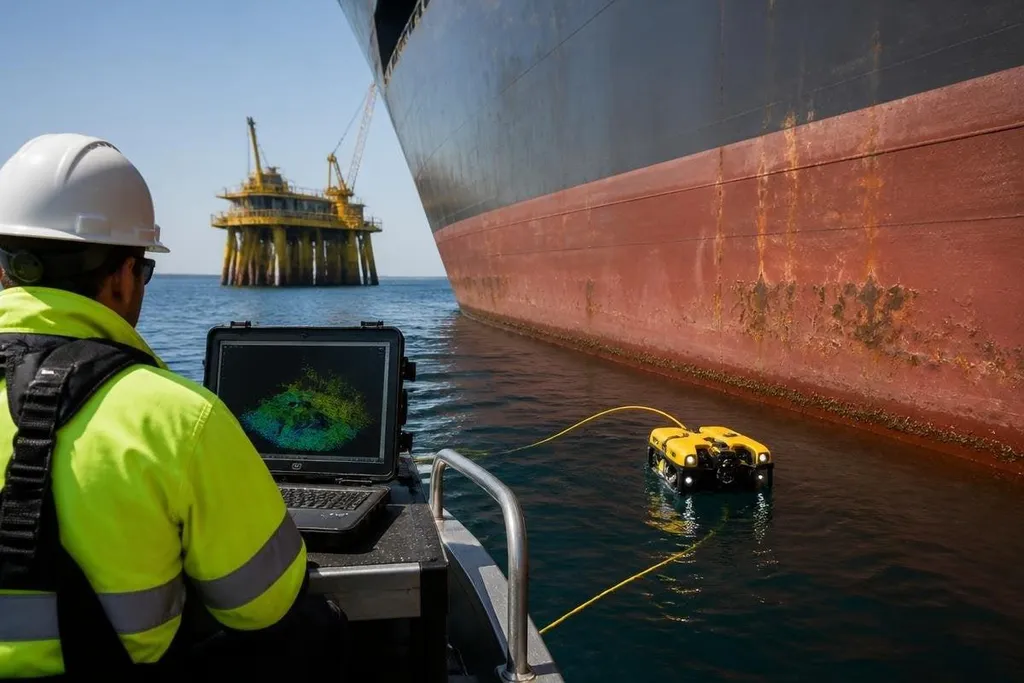
A marine robot can inspect a hull, map a seabed, or check an offshore structure without putting a person in the water.
The business opportunity sits in the work around those jobs: operating the robot, processing its data, and turning the results into a report a customer can use.
- Inspection firms can sell repeat visits instead of one-off robot rentals.
- Ports, energy companies, and fish farms need records from hard-to-reach places.
- The buyer usually pays for a trusted answer, not the robot itself.
Where the paid work is
Inspection is the clearest starting point. A remotely operated vehicle, or ROV, stays connected to a surface vessel through a cable while an operator guides its camera, lights, and tools. That setup suits ship hulls, seawalls, pipelines, dams, and offshore equipment.
The customer may need to know if a surface has cracks, corrosion, marine growth, or damage. A service company can deliver video, still images, measurements, and a written record. The robot does the viewing, while trained staff turn that raw material into a decision.
Mapping creates a second path. An autonomous underwater vehicle, or AUV, follows a planned route without a live cable to the surface. It can carry sonar and other sensors that map the shape of the seabed, channels, wreck sites, or construction areas.
That data has value before work starts. A port can use a seabed map when checking dredging needs. An offshore contractor can use it to plan cable routes. A research team can pay for repeated surveys of the same area, which creates demand beyond a single project.
The customer pays for a result
Selling a robot alone is a difficult business for a small company. The buyer must still find an operator, arrange a vessel, manage the data, and decide what the images mean. A service package removes those separate tasks from the customer’s list.
This is why repeat contracts matter. A hull inspection before repair can become a scheduled inspection after repair. A fish farm can request checks of nets, anchors, and cages at set intervals. A port can order new surveys when construction changes the seabed.
Surface robots add another option. An unmanned surface vessel, or USV, travels across the water while carrying cameras, sonar, or water sensors. It can collect data across a wide area without sending a crew into every location, though a person still needs to plan the mission, watch the system, and respond when conditions change.
The business case starts with the work a marine robot can repeat and the staff still needed to run it. Marine robotics coverage from Robot24.com can place the machine, task, company, and test result beside each claim before the next section examines what makes the model difficult.
What makes the model difficult
Water is hard on equipment. Salt, pressure, poor visibility, currents, and signal loss can turn a planned job into a recovery operation. A company also needs trained operators, spare parts, insurance, a launch site, and a vessel that fits the job.
Data work brings another limit. A large video file has little value if the customer cannot find the damaged section or compare it with an older inspection. Reports need clear labels, location data, timestamps, and a method that produces similar results on the next visit.
Rules also vary by location and task. A business may need permission to operate in a port, follow vessel rules, protect restricted data, or meet inspection standards set by the customer’s industry. Those costs belong in the business plan from the start.
A practical decision guide
Before buying equipment or forming a service company, check these points:
- Name the job: define the object, depth, water conditions, and result the customer needs.
- Choose the vehicle: use an ROV for close inspection with a live feed; use an AUV or USV for planned survey work.
- Price the full job: include the vessel, crew, launch gear, insurance, data work, travel, and repairs.
- Set the report format: show how images, maps, measurements, and location data will reach the customer.
- Plan for failure: decide what happens after signal loss, bad weather, sensor damage, or a stuck vehicle.
- Sell repeat work: ask what changes after the first inspection and when the customer will need another visit.
I’d start with a narrow inspection service, where the object, report, and buyer are easy to name. Building a robot before proving that paid job is usually the expensive part.
The next useful step is a small field plan: one target site, one defined report, and one customer willing to pay for the result.